











The Today section collects fixtures scheduled within the current calendar day and attaches a statistical forecast to each one. Football fills most of the schedule, with basketball and tennis alongside it, so a single page covers much of what Nigerian fans follow from afternoon to late night.
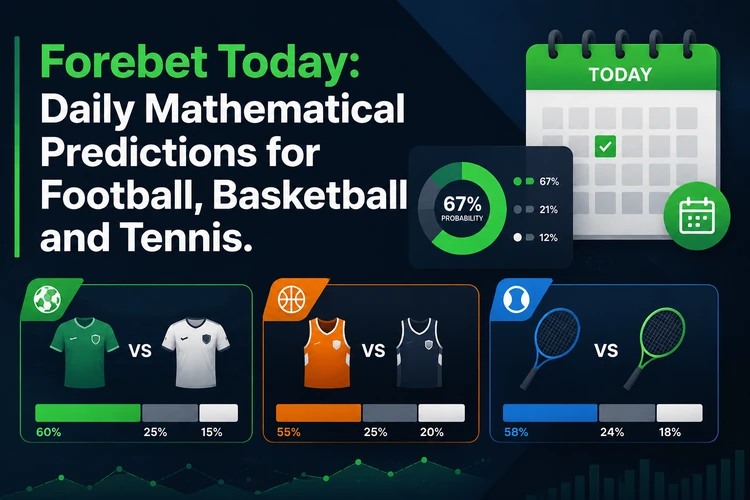
Numbers can move during the day. A striker may return from injury, a team may change its starting goalkeeper, or a mid-table side may win several matches in a row. The model can then recalculate, which is why the forecast for a fixture may look different in the morning and shortly before kick-off. Checking the figures more than once is useful, but each check should be treated as an updated estimate rather than a promise.
What Is Forebet Today?
It is an automated daily feed of match forecasts. Instead of a pundit choosing a favourite, an algorithm processes historical results and current-season data, then outputs probabilities for each possible outcome. The process is designed to measure patterns rather than follow club popularity or dramatic headlines.
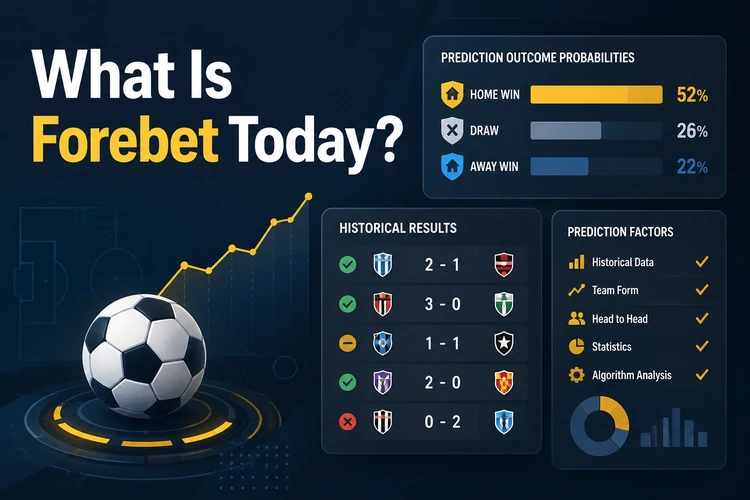
The distinction from expert opinion matters in practice. A columnist may weigh a manager's press conference or dressing-room rumours; the model weighs measurable events such as goals scored, goals conceded, points per game and minutes played by key players. Both approaches have blind spots. Reading a mathematical forecast alongside confirmed team news gives a broader view than relying on either source alone.
How Today's Predictions Are Generated
The calculation starts with recent results, weighted so that the latest matches have more influence than games from several months ago. Home form and away form are handled separately, because many sides perform differently in their own stadium. Winning or losing streaks can adjust ratings, although a short streak should not be treated as proof that a team has permanently changed.
Goal statistics shape the projected scoreline: average goals scored, average conceded and the frequency of clean sheets all matter. Expected goals data focuses on chance quality rather than only finished chances, helping to identify teams whose league position may be affected by short-term luck. Head-to-head history and overall team ratings add context, while playing tendencies such as high pressing or a low block can influence the likely pattern of the match.
- Form weighting: recent fixtures carry more influence than older ones.
- Venue split: home and away records are modelled as separate profiles.
- Goal averages: scoring and conceding rates shape Over/Under and correct score figures.
- Expected goals: chance quality helps separate performance from short-term variance.
These inputs are not equally reliable in every competition. A top division with regular line-ups and a large statistical record usually provides a firmer base than a youth competition or a newly promoted league with limited comparable data.
Football Predictions Today
Coverage runs from the Premier League, LaLiga, Serie A, Bundesliga and Ligue 1 down to second and third divisions across Europe, as well as leagues in Africa, South America and Asia. Nigerian readers may also find NPFL fixtures and CAF competitions when they are in season.
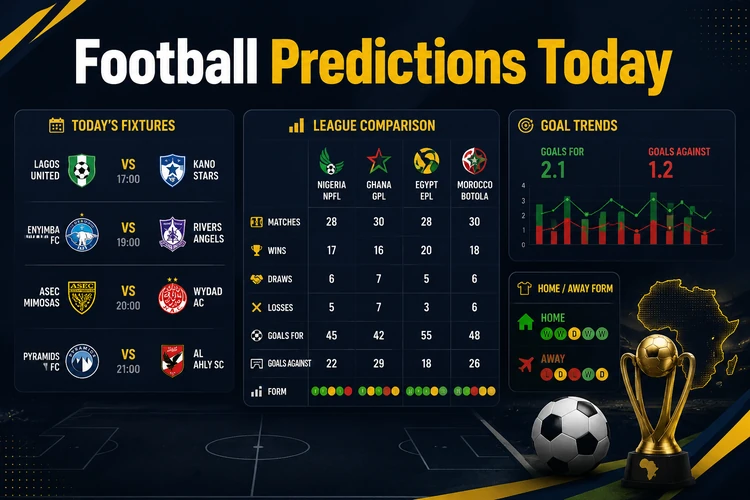
International tournaments, continental club competitions, youth leagues and domestic cups appear as the calendar allows. Cup ties deserve extra caution: rotated line-ups and single-leg formats widen the range of plausible results, so probabilities may sit closer together than they would in a league match between the same clubs. When today’s schedule is short, the fixtures scheduled for tomorrow provide another date to compare.
Basketball and Tennis Predictions Today
Basketball forecasts cover the NBA, EuroLeague, national championships and international windows. Scoring volume changes the maths: with many points in a typical game, totals and margins can carry more information than a simple win-or-lose call. Pace, offensive efficiency, defensive efficiency, injuries and home-court advantage are especially relevant.

Tennis is modelled player by player across ATP, WTA, Challenger and ITF events. Surface record, recent match load, ranking gap and prior meetings all count. A player who has travelled between tournaments or played several long matches may be less predictable than the ranking alone suggests. Lower-tier draws are also noisier because form data is thinner and withdrawals are more common.
Prediction Types and Reading the Numbers
Each fixture can carry several outputs, and knowing what they answer prevents misreading them.
| Type | What it shows |
|---|---|
| Match Winner / 1X2 | Probability of a home win, draw or away win |
| Double Chance | Two of the three results combined into one call |
| Over/Under | Likelihood of total goals or points passing a set line |
| BTTS | Chance that both teams find the net |
| Correct Score | The single most probable exact scoreline |
| Expected Goals | Modelled goal output based on chance quality |
A 62% home figure does not mean the home side will win. It means that, across many comparable matches, roughly six in ten would be expected to end that way. Correct score is the least reliable line by nature: even the leading scoreline in a football match often remains a low-probability outcome. Use it to understand whether the model expects a tight or open game, not as certainty.
Ordered by League
Sorting the day's list by competition makes it easier to compare like with like. Scoring norms differ sharply: an Over 2.5 call in the Eredivisie sits on a different baseline from the same line in a defensive second division. Reading a complete league block makes those differences easier to notice.
League grouping also helps anyone who follows one competition closely. Familiarity with team news, travel demands and fixture congestion can help you question an unusual rating rather than accept it automatically. You can also review the full prediction listing to compare the available match details.
Daily Mathematical Analysis
A mathematical model converts historical and current data into estimated probabilities. It does not know the result in advance. Its value is in applying the same framework to many fixtures, reducing the effect of personal preference and making the assumptions visible through figures such as win probability, projected goals and totals.
Daily updates matter because the information around a match changes. A confirmed line-up, suspension, weather issue or late withdrawal can alter the expected balance. The forecast may therefore move even when the fixture itself has not changed. A movement is a signal to investigate the new information, not evidence that the latest number is guaranteed to be correct.
For a sensible reading, compare several related figures. A strong home probability with a low expected-goals total suggests control in a potentially narrow match; a high total with similar win probabilities may point to an open contest where either side can prevail. Context from the competition and the size of the underlying sample should always be considered.
Responsible Use
Everything here is analytical information, not advice and not a guarantee. Football, basketball and tennis remain unpredictable, and no model converts probability into certainty. A forecast should not be described as a sure win, particularly when the available data is limited or team news is incomplete.
Set limits before using the data, never stake money needed for essentials, and take a break when betting stops being enjoyable. Betting is restricted to players aged 18+ in Nigeria, and our notes on keeping play under control outline practical steps and support options.
FAQ
The model can recalculate during the day as relevant data arrives, including confirmed line-ups, late injury news and results from earlier fixtures. Figures shown in the morning may differ a few hours before kick-off, so a later update is the more current estimate, not a guarantee.
It expresses how often an outcome would be expected across a large sample of comparable matches. A 55% home-win figure means the home side is favoured, but the other outcomes still have substantial combined probability. One match does not have to follow the long-term average.
Football produces many plausible scorelines, and even the most likely one is usually a relatively small percentage of all possible results. The correct-score figure is more useful for showing whether a match is expected to be tight or open than for treating one exact score as certain.
The principle is similar, but the inputs differ. Basketball relies heavily on pace, offensive and defensive efficiency, player availability and totals. Tennis uses individual player data such as surface record, ranking gap, recent workload and previous meetings.
The list can include major European leagues, lower divisions, African competitions such as the NPFL and CAF tournaments, and competitions from South America and Asia. Domestic cups, youth leagues and international windows appear when they are in season, alongside basketball and tennis events.
No. They are statistical estimates based on available performance data, and sport regularly produces results outside the most likely outcome. Use them as one source of information, consider current team news, and only risk money you can comfortably afford to lose.