











Planning ahead gives you more time to analyse upcoming matches. Predictions for fixtures scheduled the following day let you review statistical models, compare team form and study head-to-head records before kickoff. Whether you follow the Premier League, Serie A or local Nigerian tournaments, early access to analytical data helps you understand the probabilities behind each contest.

The platform covers football, basketball and tennis events across many leagues and competitions. Each prediction draws on historical performance, recent results and venue-specific statistics to produce probability estimates for different outcomes. You can filter matches by sport, sort fixtures by league and examine detailed breakdowns for individual games.
What Is Forebet Tomorrow?
This section of the site displays analytical forecasts for matches taking place the next calendar day. Instead of waiting until matchday morning, you can review projected scorelines, goal expectations and win probabilities up to 24 hours in advance. The page refreshes daily, replacing completed fixtures with newly scheduled contests.

Football dominates the schedule, with top European leagues alongside African and Asian competitions. Basketball predictions appear during NBA, EuroLeague and domestic seasons. Tennis forecasts cover ATP, WTA and Challenger events when tournaments are active. Each sport uses tailored statistical inputs, such as home advantage, rest days between games and playing surface.
Mathematical Prediction Models
Statistical algorithms process large sets of match data to estimate outcomes. The models examine recent form by weighing results from the last six to eight games, with added attention to performances against opponents of similar strength. Home and away records are analysed separately, since venue affects scoring patterns and defensive stability.
Expected goals calculations play a central role in football forecasts. The system evaluates shot quality, conversion rates and defensive vulnerabilities to project how many goals each side is likely to score. For basketball, the focus shifts to points per possession, pace of play and rebounding efficiency. Tennis models track serve percentages, break point conversion and performance on specific court surfaces.
No algorithm is perfect. Injuries, tactical changes and motivation can shift probabilities in ways that raw statistics cannot fully capture. Treat every forecast as an analytical estimate rather than a certainty. The models aim to highlight likely patterns in upcoming fixtures, not to predict every result with absolute accuracy.
Correct Score Predictions
Among the hardest forecasts to produce, correct score estimates attempt to identify the exact final scoreline. The model combines expected goals for both teams, historical scoring distributions and league-specific patterns to highlight the most probable outcomes. A 1-1 draw might carry a 12% probability, while a 2-0 home win sits at 9%.
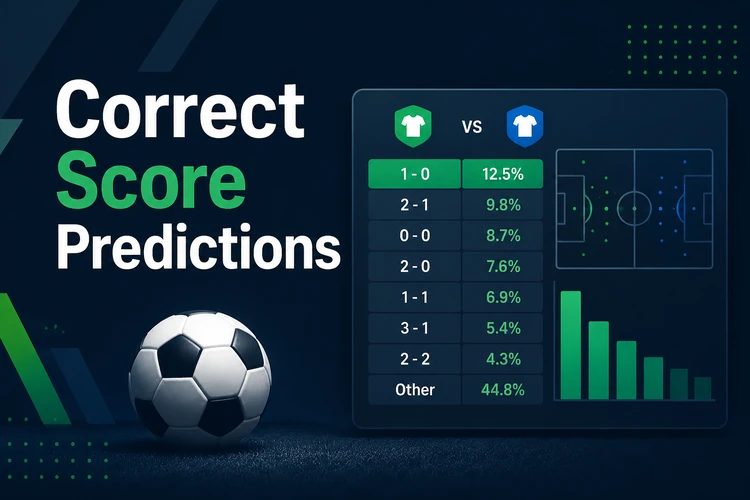
These probabilities are low by design. Football matches can end in dozens of different scorelines, so any single result represents a small fraction of possible outcomes. Use correct score forecasts to understand scoring trends rather than to lock in one result. If the model repeatedly projects low-scoring games in a league, that can point to strong defensive structure or cautious tactical setups.
Organised by League
Sorting fixtures by competition makes it easier to focus on the tournaments you follow most closely. The main prediction page lets you move from major European leagues to African competitions without scrolling through unrelated matches. Nigerian supporters can also compare local fixtures with international games in the same matchday view.
Each league section displays upcoming fixtures in chronological order, with kickoff times shown for the user's location where available. You can compare multiple matches within the same competition to spot patterns: does the model favour home teams in Serie A this week, or are away sides showing stronger recent form? League-specific sorting helps you notice trends that single-match analysis might miss.
Basketball Predictions
Basketball forecasts apply similar principles to a faster-paced sport. The model tracks offensive and defensive ratings, adjusted for opponent strength and game location. Pace matters more in basketball than football, since teams that push tempo generate more possessions and higher-scoring contests. Rebounding differentials and turnover rates also feature prominently in probability calculations.
NBA fixtures dominate during the American season, with European leagues and international competitions filling the calendar at other times. Each prediction may include projected point totals for both teams and a win probability percentage. As with football, these estimates reflect statistical trends rather than insider knowledge or guaranteed outcomes.
Tennis Forecasts
Tennis predictions account for head-to-head records, recent tournament results and surface specialisation. A player who excels on clay may struggle on hard courts, so the model adjusts expectations based on venue. Serve statistics, break point conversion rates and fatigue from previous rounds all influence match probabilities.
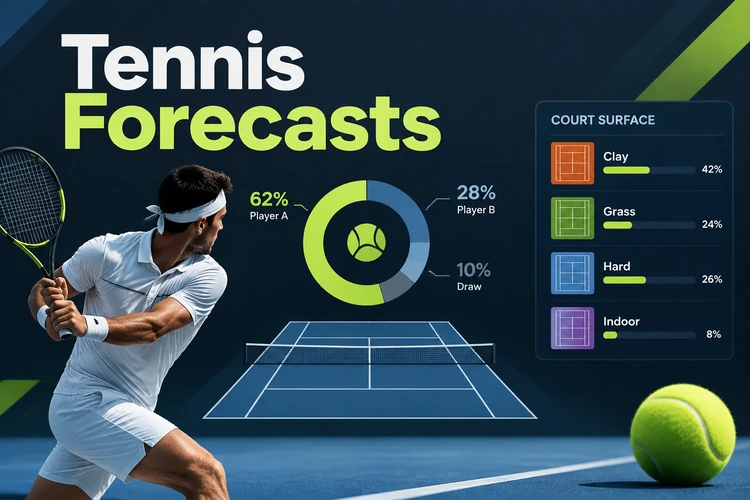
Grand Slam events, ATP Masters 1000 tournaments and WTA 1000 competitions receive the most detailed coverage. Lower-tier Challenger and ITF events appear when data quality permits reliable analysis. Match forecasts usually show win probabilities for each player rather than exact set scores, because tennis scoring systems make exact predictions less practical.
Today vs Tomorrow
Comparing same-day and next-day predictions shows how fresh information affects probabilities. A lineup announcement, weather change or late injury can shift odds in the final hours before kickoff. By reviewing predictions on the current day's page alongside those scheduled for the following day, you can see how models respond to new information.
Early predictions offer time to research team news, watch tactical analysis and form your own judgement. Last-minute forecasts may include newer data but leave less room for careful review. Both approaches have value, depending on how much time you spend preparing for matches.
Responsible Use of Statistical Analysis
Predictions are tools for understanding probability, not instructions for decision-making. Every model has blind spots. A team might be changing manager, dealing with fixture congestion or missing a key player. These factors can reduce the usefulness of older performance data.
Use forecasts as one input among many. Watch matches when possible, read tactical breakdowns from experienced analysts and consider context that numbers miss. No algorithm can account for every variable in a live sporting contest. Treat analytical estimates as helpful guides, and never stake more than you can afford to lose. For safer play principles, read the responsible gambling guide.
FAQ
A mathematical prediction uses statistical models to estimate outcomes for fixtures scheduled the next day. It may analyse team form, historical results, expected goals and other data points to calculate probabilities for scorelines and results.
The page refreshes daily as completed matches are replaced by newly scheduled fixtures. Probability estimates may adjust as kickoff approaches if meaningful team news or schedule changes become available.
Yes. The platform covers football, basketball and tennis when events are available. Each sport uses different statistical inputs, so football score projections should not be interpreted in the same way as tennis win probabilities.
Coverage can include major European competitions, African leagues, Asian tournaments and international fixtures. The exact selection depends on the season and the competitions active on a given matchday.
Correct score predictions carry high uncertainty because a football match can finish with many different scorelines. They are best used to understand scoring patterns, not as definitive results.
No. Predictions are analytical tools based on available data. They cannot account for every injury, tactical change or match situation, so they should be combined with your own research and responsible bankroll limits.